Why Vietnam eVisa Applications Get Rejected or Delayed (and How to Avoid It)
Written by Andrew Duong, visa consultant at Joey Visa Vietnam · Last updated:
The most common reasons Vietnam eVisa applications are rejected or delayed, and how to check and fix each one before you submit.
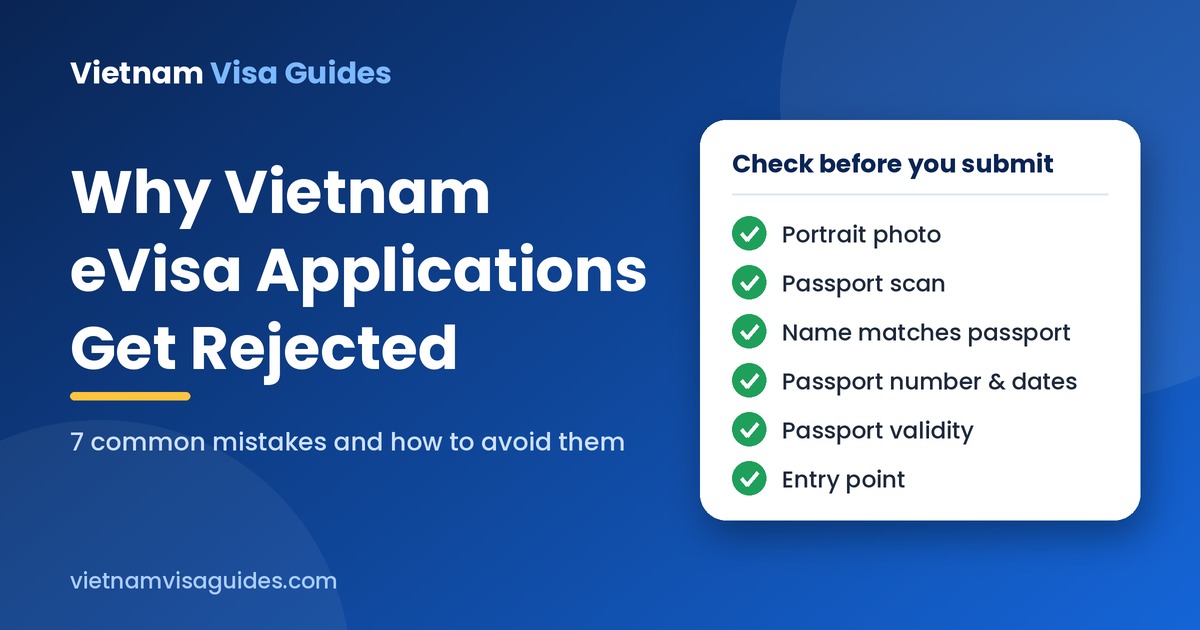
Most Vietnam eVisa problems come from a small number of fixable details: a portrait photo that does not meet the requirements, a blurry or incomplete passport scan, a name that does not match the passport exactly, or a typo in the passport number or dates. Checking these before you pay and submit prevents most delays. Final approval is always decided by Vietnam Immigration, and no service can guarantee approval.
Why this guide exists
The official portal often gives a generic message when an application is returned or refused, so it can be hard to know what went wrong. Below are the problems most commonly reported by applicants and visa guides, with how to avoid each one. The photo and passport-scan rules in particular follow the specifications on the official portal at evisa.gov.vn, which you should always check for the latest requirements.
1. The portrait photo does not meet the requirements
What happens: the application is returned for correction or refused.
Why it happens: photo problems are among the most frequently reported causes. Typical issues are a selfie or cropped holiday photo, a dark or patterned background, glasses or a hat, glare, low resolution, or a photo that is too old to look like your passport photo.
How to avoid it: use a recent, passport-style photo taken facing the camera against a plain white background, with no hat and no glasses. Do not crop a larger photo until it becomes blurry, and keep the file within the size and format limits shown on the portal.
2. The passport scan is blurry, cut off or the wrong page
What happens: the officer cannot read your details, so the application is returned or refused.
Why it happens: common mistakes are glare across the data page, cut-off corners, blur, an unreadable machine-readable zone (the two lines of letters, numbers and < symbols at the bottom), or uploading the passport cover instead of the page with your photo and personal details.
How to avoid it: upload the full photo page of your passport, flat and well lit, with all four corners and both machine-readable lines clearly visible. Use a scan or a straight-on photo, and zoom in to check that every character is legible before you upload.
3. The name does not match the passport exactly
What happens: the application can be returned, or the eVisa can be issued with a name that does not match your passport. An airline or immigration officer may then question it.
Why it happens: leaving out a middle name, putting your first name in the surname field, reversing the order, using a shortened name, or differences in spacing and hyphens.
How to avoid it: copy your name exactly as printed in your passport, including every given name, and compare it with the machine-readable lines at the bottom of the photo page. Your surname is your family name. Your given names include your first name and all middle names.
4. Typos in the passport number, date of birth, sex or email
What happens: the eVisa may be refused, or it may be approved with wrong details that cause problems when you check in or arrive.
Why it happens: one wrong character in the passport number, confusing letters and numbers that look alike, a swapped day and month, or a wrong email address so you never receive the result.
How to avoid it: read every field back against your passport before paying. Check the email address twice, because the result is sent there. When your eVisa arrives, check it again against your passport straight away. If anything is wrong, deal with it before you travel, not at the airport.
5. The passport is close to expiry
What happens: the application can be refused, or you may be turned away when travelling.
Why it happens: Vietnam generally requires your passport to be valid for at least six months from your date of entry, and applicants often forget to check.
How to avoid it: check the expiry date of your passport before you apply. If it is close to expiring, renew the passport first.
6. Wrong entry or exit point, or dates that do not line up
What happens: the application may be returned, or you may have trouble entering through a gate you did not select.
Why it happens: choosing a border gate that is not on the approved list, or entering the arrival and departure dates incorrectly.
How to avoid it: pick the entry point where you will actually arrive, and check it against the full list of 83 approved eVisa border gates. Make sure your arrival date is correct and that your stay fits within what the eVisa allows.
7. A vague refusal message and no clear reason
What happens: you receive a refusal or correction request that does not explain the cause.
What to do: check your portrait photo and passport scan first, then compare your name, passport number and dates with your passport one character at a time. Fix the problem and submit a corrected application. Keep in mind that the government fee is non-refundable, so a careful check before the first submission saves both time and money.
Check this before you submit
- The photo is recent, plain white background, facing the camera, no hat or glasses.
- The passport scan shows the full photo page, all corners and both machine-readable lines, with no glare.
- Your name matches the passport exactly, including every middle name.
- Passport number, date of birth, sex and email address are correct.
- Your passport is valid for at least six months from your entry date.
- Your entry and exit points are on the approved list.
- Your arrival date is correct and you have allowed enough time for processing.
What we check when we review an application
When you use our service, every application is reviewed by a real person before it is submitted to Vietnam Immigration. We compare each field with your passport, look at the photo and scan for the problems above, and contact you if something needs fixing before submission. This does not guarantee approval, because the decision is made by Vietnam Immigration, but it removes the most common avoidable errors.
[Andrew: add one or two real observations from your own applications here, for example the problem you see most often and a short anonymous example. Remove this line if you do not add any, and do not include names or passport details.]
If your application is rejected
Read any message from the portal, fix the cause using the steps above, and submit a corrected application. If you are travelling soon, look at our urgent eVisa options and message Andrew on WhatsApp for an honest assessment of your options. [Andrew: add what happens under your own service if an application is refused, in line with your Terms & Conditions.]
Frequently asked questions
Why was my Vietnam eVisa rejected?
The most commonly reported causes are a photo that does not meet the requirements, an unreadable passport scan, a name that does not match the passport, and typos in the passport number or dates. The portal often gives only a generic message, so check these items first.
Can I reapply after a rejection?
Yes, you can submit a corrected application after fixing the problem. The government fee is non-refundable, so check every detail before you submit.
Does using an assisted service guarantee approval?
No. Final approval is decided by Vietnam Immigration. An assisted service can review your application for common errors before submission, but no service can guarantee approval or an exact delivery time.
Can I apply for a Vietnam eVisa myself?
Yes. You can apply directly on the official portal, evisa.gov.vn. See our comparison of the official site and an assisted service to decide which suits you.
Do I need to do anything else before arriving in Vietnam?
Vietnam has introduced a free online pre-arrival declaration at major airports. It is separate from the eVisa. See our guide to Vietnam entry requirements.
Next steps
Need a person to check your application before you submit? Message Andrew on WhatsApp or start an application.
Explore Topics
Written by
Andrew Duong — Joey Visa Vietnam
Content creator and writer sharing insights and stories.