Urgent Vietnam Visa Help for Self-Transfer Flights
Written by Andrew Duong, visa consultant at Joey Visa Vietnam · Last updated:
An urgent Vietnam visa for self transfer flights may help you board on time. Learn when immigration requires a visa, what to prepare, and check urgent options.
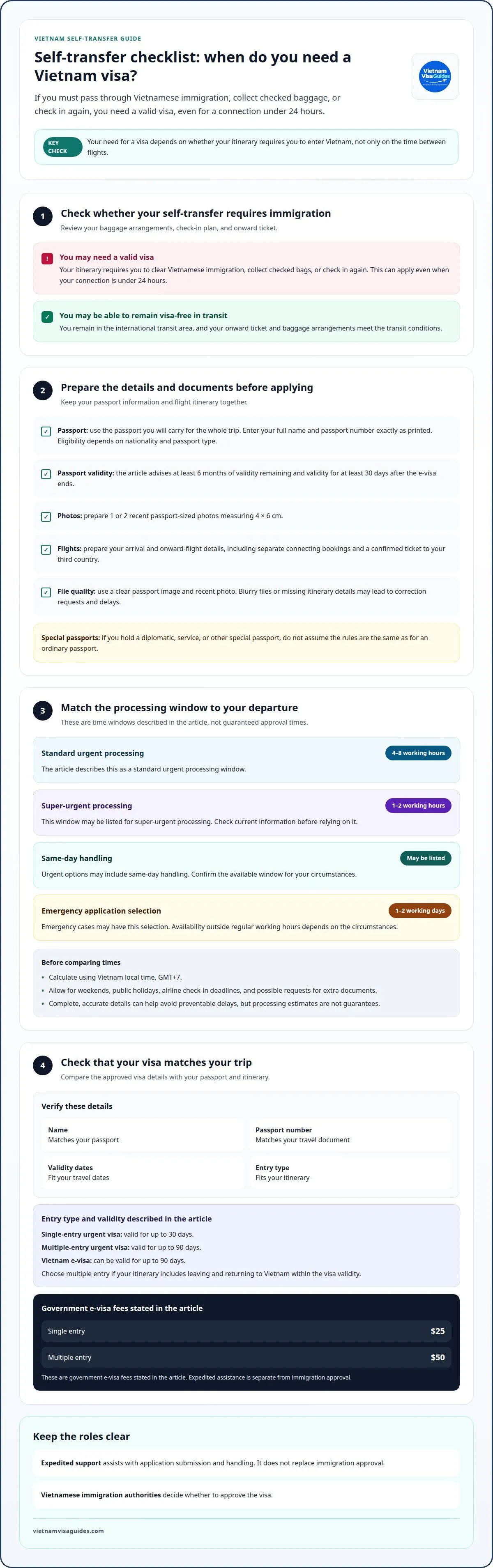
A short layover doesn’t automatically let you stay airside. If your self-transfer requires you to clear immigration, collect checked bags, or check in again, you need a valid Vietnam visa, even when your connection is under 24 hours. An urgent Vietnam visa for a self-transfer may be the practical option when your flight is close.
It’s understandable to focus on the time between flights, but whether you must enter Vietnam matters just as much. Travelers who remain in the international transit area may avoid a visa when their onward ticket and baggage arrangements meet the transit conditions. This guide explains how to tell which situation applies, what to prepare, and how urgent visa options fit different departure timings, including flights within 24 hours. You’ll also learn when expedited processing may help and what to do if your itinerary requires you to pass through immigration.
Key Takeaways
- Work out whether your self-transfer requires you to clear Vietnamese immigration, collect baggage, or check in again.
- Match your departure deadline to the available urgent processing options, and account for Vietnam local time.
- Prepare the required passport details and recent photo so an urgent application can be submitted with the necessary information.
- Understand when remaining in the international transit area may avoid a visa, and when your itinerary may require one.
How to get an urgent visa for Vietnam fast & easy?
Start by confirming that your self-transfer requires you to enter Vietnam, then prepare your passport and onward-flight details. Vietnam e-visas can be valid for up to 90 days, according to the Vietnam Immigration Department.
Eligible Passport Types
Eligibility depends on your nationality and passport type, so use the passport you will carry for the entire trip. Enter its details exactly as printed, including your full name and passport number. If you hold a diplomatic, service, or other special passport, don’t assume the same application rules apply as for an ordinary passport. Review the Vietnam emergency visa passport requirements before submitting.
Passport Validity and Stay Limits
Your passport should have at least 6 months of validity remaining, and it must remain valid for at least 30 days after your e-visa ends. Match the e-visa dates to your departure and connecting flight; approval does not extend your passport’s expiry date. A single-entry urgent visa can be valid for up to 30 days, while a multiple-entry urgent visa can be valid for up to 90 days. Your permitted stay follows the dates and entry terms shown on the approved visa.
What Should Your Onward Ticket and E-Visa Show?
Keep a confirmed ticket for travel to your third country with your application details. During a self-transfer, separate bookings may mean collecting your baggage and checking in again. If that requires you to pass through Vietnamese immigration, arrange a valid visa, even for a short layover. Before departure, check that your eVisa shows the correct name, passport number, validity dates, and entry type.
Vietnam Immigration Department lists the government single-entry eVisa fee as $25 and the multiple-entry eVisa fee as $50. An approved e-visa can cover entry through airports, land ports, and seaports. Choose single entry for one visit, or multiple entry if your itinerary includes leaving and returning to Vietnam within the visa’s validity.
Urgent applications for travelers flying within 24 hours
If your flight leaves within 24 hours, first establish whether your itinerary requires you to enter Vietnam. A self-transfer that involves collecting baggage or checking in again may require you to clear immigration.
What should you do if your flight is within 24 hours?
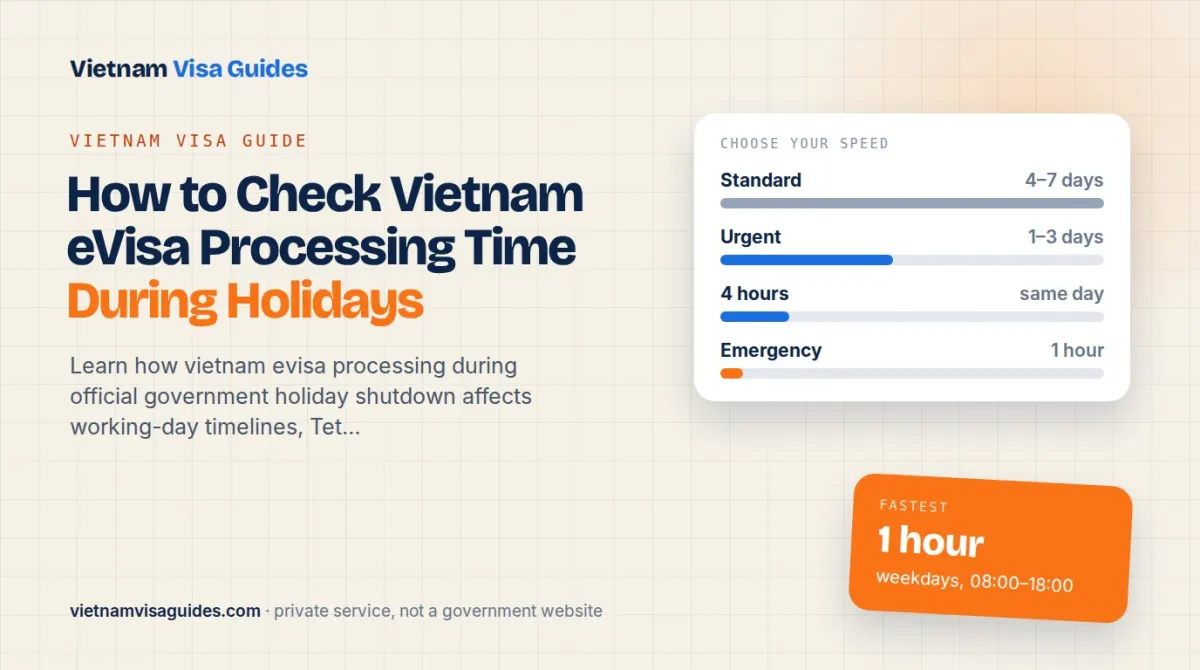
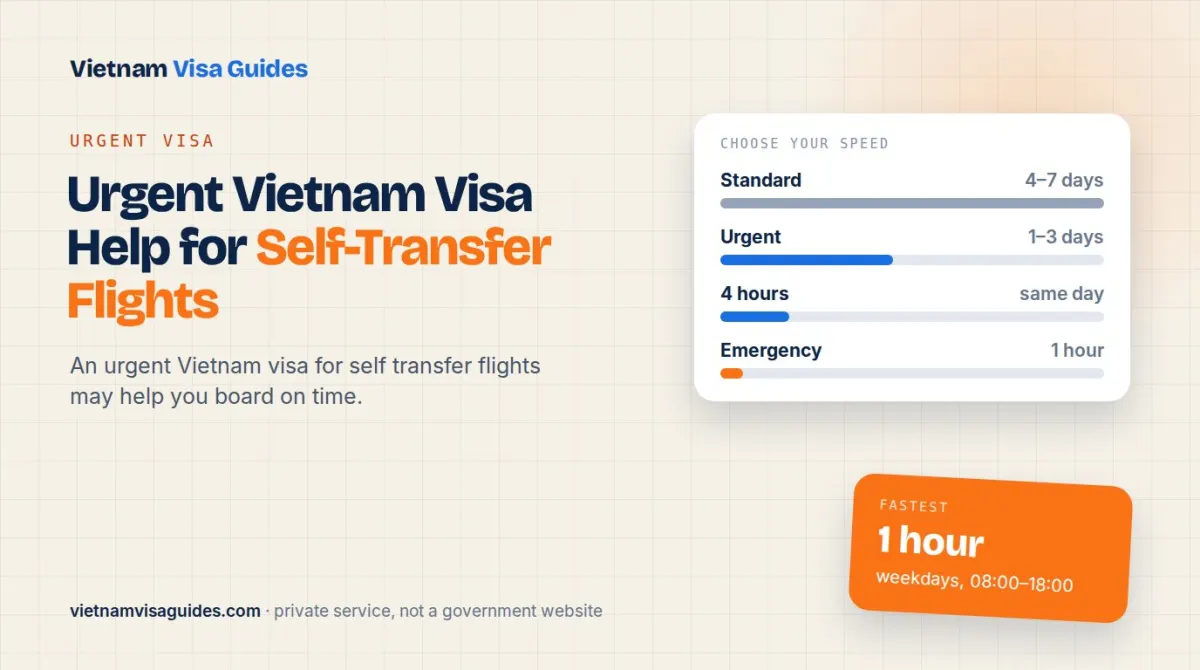
Compare your departure time with the processing window, using Vietnam local time for the calculation. Our urgent options run from 3 working days down to 4 hours, and Emergency 1 hour delivers 1 hour after you apply (Monday to Friday, 08:00–18:00). A Weekend Emergency option covers applications from 18:00 on Friday. If your nationality qualifies for visa-free entry, your situation may differ. Confirm whether the exemption applies to your planned entry before preparing an application.
How is an urgent application reviewed and submitted?
Prepare your passport details, intended arrival information, and connecting-flight itinerary together. Enter your details accurately: a mismatch can cause problems at airline check-in or boarding. With separate tickets, include onward travel details showing how you will leave Vietnam. Before submitting, compare your name, passport number, and travel dates with your documents. Review the application for missing information to avoid preventable delays.
Which documents should you prepare?
Gather the required documents before you start, so you can submit a complete application:
- A passport with clear, readable personal details.
- A recent selfie photo (no printed photos are needed).
- Arrival and onward flight details, including separate connecting bookings.
Use a clear passport image and a recent photo. Blurry files or missing itinerary details may prompt a request for corrections and delay processing.
How are emergency applications handled?
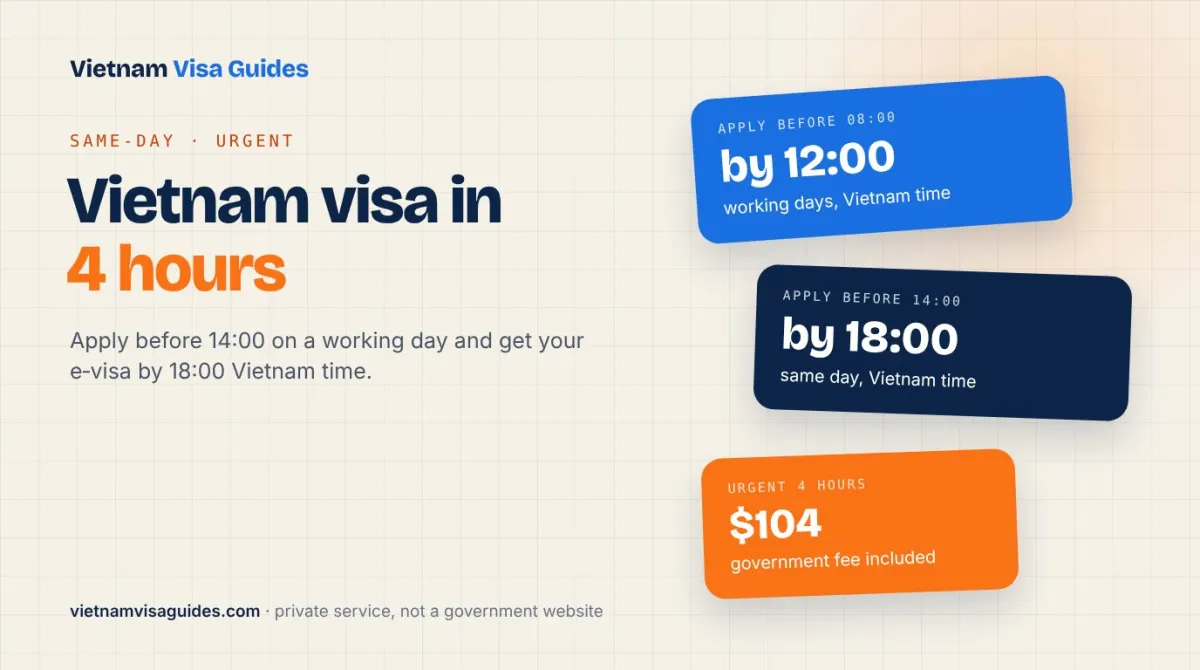
Choose a processing window that fits the time remaining before departure. Urgent options take 1–3 working days, while the 4-hour and 1-hour options are handled within the same day. Working hours, weekends, and public holidays affect the available processing window. Submit complete documents promptly, and keep your airline booking information accessible while the application is reviewed.
Which urgent Vietnam visa for a self-transfer fits your departure?
Choose an option based on the time remaining before arrival and the latest processing information. Standard eVisa processing and urgent assistance have different timelines, so check current processing information before comparing it with your departure deadline.
Which processing option fits your travel plans?
For a planned trip, the standard e-visa route may suit you if there is enough time for immigration review. Urgent processing is a separate assistance option for closer departures. The fastest option, Emergency 1 hour, delivers 1 hour after you apply on weekdays; delivery times are guaranteed for complete, correct applications, but approval is not. Consider your remaining time and whether your application is complete, rather than relying only on the flight date. Vietnamese immigration authorities decide whether to approve the visa.
How should you compare turnaround times?
Urgent options range from 1 hour (weekdays, 08:00–18:00) to 3 working days, with a weekend option from 18:00 on Friday. Processing time is calculated using Vietnam local time, GMT+7. Compare that time with your departure and the airline’s check-in deadline. Weekends and holidays can affect when an application is handled. Leave time for review or a request for additional documents, especially if your self-transfer leaves little room between flights.
How does urgent e-visa processing work?
Expedited support assists with application submission and handling, but it does not replace immigration approval. Keep your passport details, arrival date, entry information, and onward itinerary consistent. Any visa approval document or letter must match your travel details and visa requirements. You can compare standard processing details in this guide to Vietnam e-visa processing times.
What timeline does official processing guidance give?
Standard Vietnam e-visa processing takes 4–7 working days. These are estimates for the official route, not urgent-service turnaround promises. Check the latest official processing information, as immigration review may take longer if additional documents are requested, holidays affect processing, or checks continue. Submit accurate information early, then use the approved visa dates and entry details when confirming your arrival plans.

Travel situations that may require an urgent visa
Yes, you may need an urgent Vietnam visa for a self-transfer if your itinerary requires you to clear immigration. This applies even when your connection is under 24 hours, because the transit-area rules depend on whether you remain airside.
Separate tickets can mean collecting checked baggage, entering Vietnam, and checking in again. An overnight layover can also create visa needs if it exceeds 24 hours or requires you to leave the airport transit area.
Travelers who remain in the international transit area generally need a confirmed onward ticket and baggage checked through to their final destination to meet visa-free transit conditions. If you need to collect your bags or change terminals through immigration, arrange a valid visa before departure.
For transit without a visa, the layover must be less than 24 hours and you must remain in the transit area. Your nationality matters too: visa-exempt travelers generally do not need a visa for transit, while other travelers may need one if they leave the transit area or stay longer.
Your onward journey matters too. Travelers transiting through Vietnam need a suitable ticket to a third country and must hold a visa for that destination unless exempt. Before traveling, confirm that your documents cover both entry into Vietnam and your next destination.
Vietnam visa on arrival is described as an option for travelers arriving by air, but it requires an approval letter before travel. It is not a document you can obtain simply by arriving at the airport. If your flight is close, urgent assistance may help you submit an application, but Vietnamese immigration authorities decide visa approval. Standard e-visa processing typically takes 4–7 working days, so it may not fit every last-minute departure.
Vietnam Visa Guides | Urgent Vietnam eVisa Assistance
Vietnam Visa Guides | Urgent Vietnam eVisa Assistance helps travelers choose a suitable urgent visa route when a self-transfer requires entry into Vietnam. Its Vietnam eVisa Urgent and Urgent & Same-Day Vietnam Visa services support travelers facing close departure deadlines. Emergency Vietnam Visa in 1 Hour, on Weekend is another option for urgent cases.
Vietnam Visa Guides also provides Fasttrack Airport assistance, including support through the priority lane at the immigration counter. This service is separate from eVisa processing, and Vietnamese immigration authorities make the visa approval decision. Share your flight timing, passport details, and whether you need to collect baggage or clear immigration so the assistance suits your itinerary.
Vietnam Visa Guides offers urgent Vietnam eVisa assistance for self-transfers and other visa needs.
Make your next step with a clear itinerary
Before changing your travel plans, map the route you will actually take through Vietnam. An urgent Vietnam visa for a self-transfer must match your real itinerary, not an earlier booking. Keep your flight information and passport details together so you can explain your situation clearly when seeking assistance.
If time is short, focus first on whether your itinerary requires you to enter Vietnam. Share the relevant travel details with Vietnam Visa Guides to discuss urgent eVisa assistance. Vietnamese immigration authorities decide whether to approve a visa, so an expedited processing target is not a promise of entry.
Take the next step calmly. A clear plan helps you decide what to do next.
Frequently Asked Questions
How do I apply for a Vietnam e-visa, and what should I prepare?
You can apply through the government eVisa portal or use a private assistance service. Have your passport, photo, travel dates, and intended entry point ready. Enter details exactly as they appear in your passport, then review the application before submission. Check carefully for spelling and date errors that could affect your travel plans.
Do I need a visa to collect and recheck baggage during a self-transfer?
If collecting baggage requires you to pass through Vietnamese immigration, you need permission to enter Vietnam unless you qualify for an exemption. Ask your airline whether it will check your bags through to your final destination and whether separate bookings require a new check-in. These details help establish whether you can stay airside or must enter Vietnam.
How long does processing take, and are urgent options available?
Government eVisa processing and urgent-service targets have different timelines, so use the target for the option you choose. Vietnam Visa Guides offers urgent and emergency eVisa assistance for close departures, but immigration authorities decide whether to approve each application. Leave time for review or a request for more information. Do not assume a visa will be approved before boarding just because your connection is tight.
How much do Vietnam e-visas and urgent assistance cost?
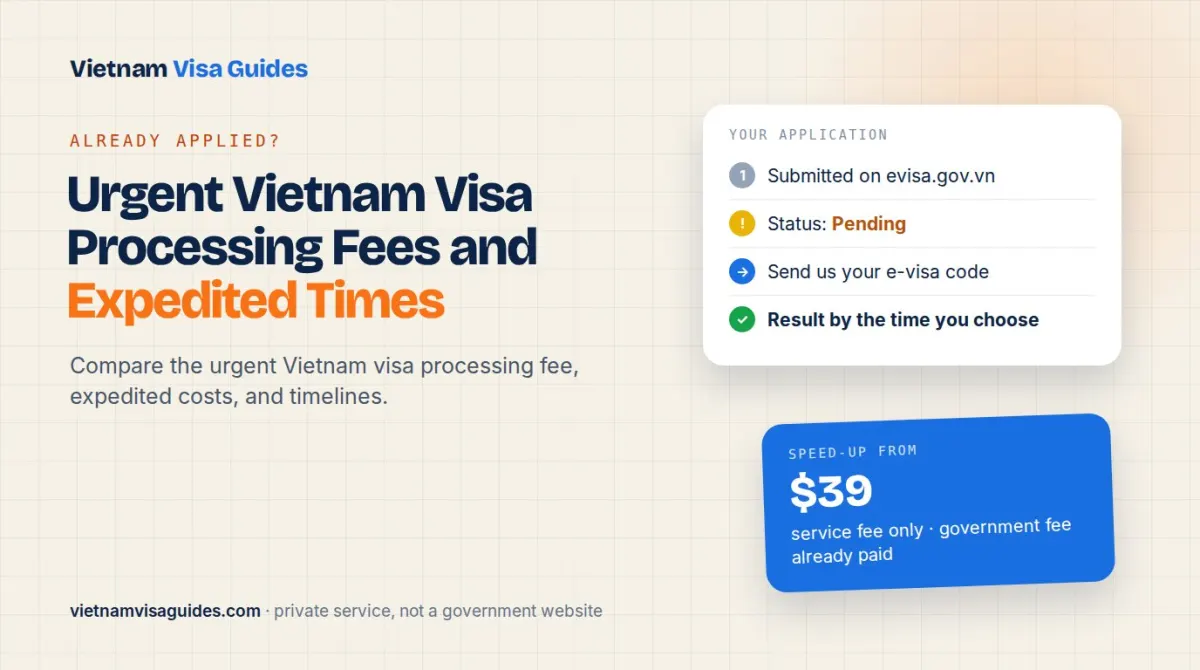
The government e-visa fee depends on whether you select single or multiple entry. Urgent assistance has a separate service cost, which varies by processing option. At Vietnam Visa Guides, the listed urgent prices already include the government fee ($25 single entry, $50 multiple entry). Confirm the current total cost for your chosen route and entry type before paying, so you can avoid relying on an outdated amount.
Can I enter through my self-transfer airport with an e-visa?
Your eVisa is valid at any of the 83 eVisa border gates (17 airports, 27 land borders and 39 seaports), so a change of arrival airport does not mean a new application. If your itinerary changes, just check that the new airport is one of those gates.
Can an airline deny boarding for a self-transfer without a Vietnam visa?
If your self-transfer requires you to clear Vietnamese immigration, you need a valid Vietnam visa. Incorrect or mismatched travel details can cause problems at check-in or boarding.

Article by
Andrew - Vietnam Visa Guides
I'm Andrew (Hoàng Tùng Dương, "Duong" to many of my clients), a visa consultant at Joey Visa Vietnam since 2017.
I help travellers from all over the world get their Vietnam e-visa quickly and without mistakes, including urgent visas in as little as 1 hour and on weekends.
Together with the Joey Visa team, we've helped more than 155,000 travellers since 2017.
Explore Topics

Written by
Andrew Duong
Vietnam visa consultant at Joey Visa Vietnam since 2017. I check every application by hand, including urgent and weekend e-visa cases.