Vietnam Entry Visa Pre-Flight Checklist Reference
Written by Andrew Duong, visa consultant at Joey Visa Vietnam · Last updated:
Use the Vietnam entry visa pre flight checklist to quickly verify your approved eVisa, passport, arrival checkpoint, and travel documents before departure.
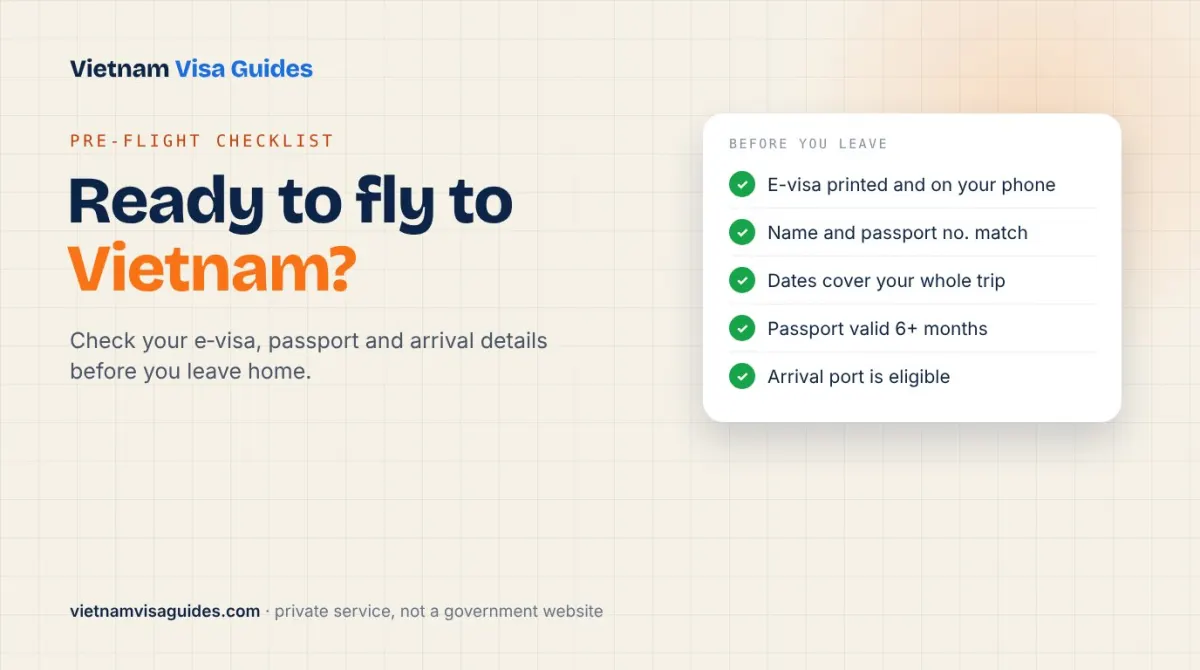
Save your approved Vietnam eVisa offline and print a copy; don’t rely on your phone alone. Use this Vietnam entry visa pre flight checklist to prepare your passport and visa, then make sure your planned arrival checkpoint matches the one on your eVisa.
It’s easy to focus on whether your eVisa opens on screen. First, confirm that it has been approved and that your travel details match the issued visa. A digital copy is convenient, while a printout gives you a paper backup.
This checklist covers the documents to prepare, what to do if your eVisa is pending, and how to review your arrival checkpoint and travel details before departure. It also explains when an entry declaration applies and why it does not replace a visa. Check requirements against your nationality, passport, travel purpose, and itinerary so you have the right documents ready to board.
Key Takeaways
- Review your passport details and visa dates before travel, and make sure the approved entry type matches your trip.
- Prepare your accommodation details and understand when proof of onward travel may matter for your entry plan.
- Match your planned arrival checkpoint to the one on your approved eVisa, especially if your route changes.
- Use your nationality, passport type, and length of stay to determine whether you need a visa or may qualify for an exemption.
Vietnam Entry Document Checklist: How to Prepare Your Passport, e-Visa, PAI Declaration, and Customs?
Prepare your original passport, approved eVisa, and any required arrival declaration before departure. The broader Vietnam pre-flight guide also covers flight preparation.
Passport Validity and Blank Pages
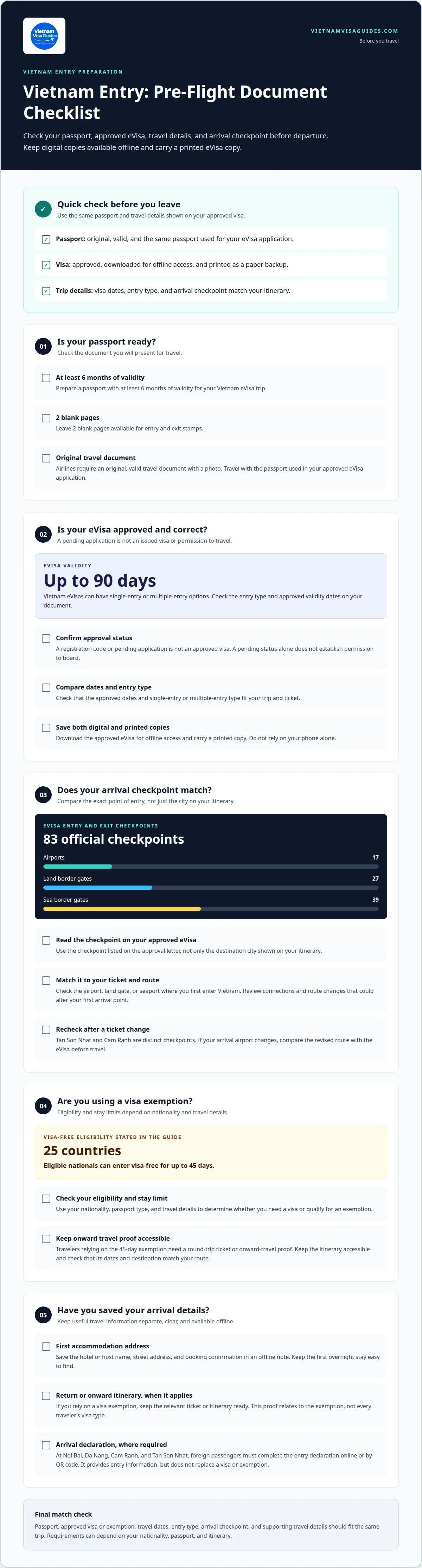
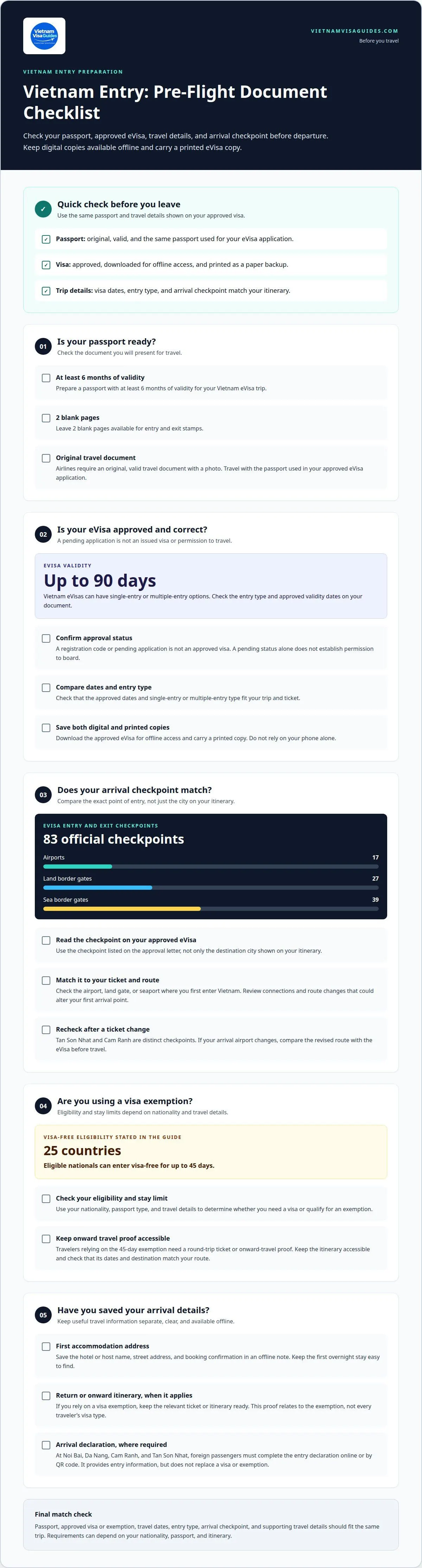
Passport validity is the period your travel document remains valid. For a Vietnam eVisa trip, prepare a passport with at least six months of validity and two blank pages for entry and exit stamps. Airlines require an original, valid travel document with a photo. Travel with the same passport used in your approved eVisa application.
E-Visa Validity and Entry Options
An eVisa is an electronic travel approval issued for a defined validity period and entry type. Vietnam eVisas can be valid for up to 90 days, with single-entry or multiple-entry options. Download the approved document for offline access and carry a printed copy. A registration code or pending application is not an issued visa or permission to travel.
Entry Type and Validity Checks
Check that the approved dates, entry type, and arrival checkpoint fit your trip. Compare the eVisa dates with your ticket, then match its listed checkpoint to your planned route. Airlines may review visa documents before boarding. A pending application is not an approval, and its status alone does not establish permission to board.
Visa Requirements and Exemptions
A visa exemption allows eligible travelers to enter without an eVisa for a limited stay. Eligibility and stay limits depend on nationality and travel details; eligible nationals of 25 countries can enter visa-free for up to 45 days. Travelers using the 45-day exemption need a round-trip ticket or onward-travel proof. At Noi Bai, Da Nang, Cam Ranh, and Tan Son Nhat, foreign passengers must complete the entry declaration online or by QR code. It provides entry information, but does not replace a visa or exemption.
Accommodation address and return or onward travel
Keep your first accommodation details and onward itinerary with your travel documents. The travel proofs you need can depend on your nationality and entry route.
Accommodation Address
An accommodation address identifies where you plan to stay in Vietnam. Save the hotel or host’s name, street address, and booking confirmation in an offline note. Keep the address for your first overnight stay separate from later bookings. Use the same planned address in any arrival registration that asks for accommodation information.
A booking confirmation can help you recall the address after a long flight. Keep it on your phone and download it for offline access. If your itinerary includes several stops, save the first accommodation details separately so they are easy to find on arrival.
Return or Onward Travel Proof
Proof of onward travel shows that your itinerary leaves Vietnam for another destination. Travelers relying on a visa exemption should check whether they need to show a return or onward ticket before departure. Keep the ticket or itinerary accessible, and make sure its destination and dates match your actual route. This requirement relates to the exemption, not every traveler’s visa type.
A one-way ticket may not show an onward route. If you are relying on an exemption, organize your return or onward ticket before departure and keep a digital copy. Airline staff may review travel documents before boarding, so keep your booking details easy to open alongside your passport.
Medicines and travel insurance are useful travel records, but they do not replace an entry document. Keep prescribed medicines in their original packaging when possible, and carry relevant prescription details. Save your insurance policy number and assistance contact offline so you can find them without an internet connection.
Plan your Vietnam travel budget around your route, accommodation, meals, and local transport. Costs can vary by destination and route. Keep payment options and booking records separate from your visa documents, but organize them with your travel papers for quick access during the journey.
Matching the entry checkpoint to the e-visa
An entry checkpoint is the airport, land gate, or seaport where you first enter Vietnam. Check that your planned arrival point aligns with the checkpoint on your eVisa approval letter. A different route can create a mismatch, even when both places are in Vietnam.
Vietnam eVisas allow entry and exit through 83 official international border checkpoints: 17 airports, 27 land border gates, and 39 sea border gates. The key check is not simply whether your destination has an international airport. Compare the exact checkpoint on your approval letter with the arrival point shown on your ticket.
For example, Tan Son Nhat International Airport and Cam Ranh International Airport are distinct checkpoints. If your ticket changes from one airport to another after your eVisa is issued, the approval letter may no longer match your planned arrival. Treat the checkpoint in this Vietnam entry visa pre flight checklist as a precise arrival point, not a city label.
Before departure, take these steps:
- Read the entry checkpoint on the approved eVisa, not only the destination on your itinerary.
- Compare it with the airport, land gate, or seaport shown on your ticket.
- Review connections and route changes that could alter where you first pass through Vietnamese immigration.
- If the details differ, resolve the mismatch before travel. Don’t assume another checkpoint will accept the same approval.
Applying for an eVisa means selecting travel details during the application. A connection through another country does not change your Vietnam checkpoint, but arriving first at a different Vietnamese airport can. If your ticket changes, use the Vietnam entry visa pre flight checklist to compare the revised route with the issued approval before boarding.
This check matters at Tan Son Nhat, Cam Ranh, and other listed airports. Airlines may review travel documents before boarding, and immigration officers check them on arrival. Reconfirm the checkpoint after any ticket change, and keep your approved eVisa downloaded for offline access.
Who needs a visa to enter Vietnam, and which nationalities are visa-exempt?
A visa exemption lets an eligible traveler enter Vietnam without an eVisa for a limited stay. For non-Vietnamese nationals, eligibility depends on passport nationality. Check whether an exemption applies before choosing an eVisa or relying on visa-free entry.
Use this simple decision process:
- Identify the nationality and passport type you will use for the trip.
- Check whether that nationality has a Vietnam visa exemption.
- Compare the exemption’s permitted stay with your planned dates and destinations.
- If you do not qualify, arrange a visa before travelling.
Vietnam’s exemptions differ by nationality. Bilateral arrangements include different permitted stays, while the unilateral exemption covers eligible nationals of 25 countries for stays of up to 45 days. Citizens of the United Kingdom qualify for a 45-day visa-exempt stay. These examples do not establish eligibility for other passport holders, so use your own nationality as the deciding factor.
Keep the scope of your trip in view. The Phu Quoc exemption applies to non-Vietnamese nationals arriving from overseas for stays of up to 30 days. It also covers certain transit itineraries that start at a Vietnamese international border gate and continue to Phu Quoc. If your plans extend beyond that island itinerary, assess the entry basis for the full trip rather than assuming one exemption covers every stop.
Visa-free entry and an eVisa are different routes. Choose based on your passport eligibility, intended stay, and full itinerary. If you qualify for an exemption, prepare the documents required for that route. If you need an eVisa, make sure your application reflects your travel plans. Choosing the right category from the start helps you avoid preparing the wrong documents.
Vietnam Visa Guides | Urgent Vietnam eVisa Assistance: Urgent & Same-Day Vietnam Visa
Vietnam Visa Guides, founded by Andrew Duong and operated by Joey Visa Vietnam, helps travellers who need an urgent Vietnam visa or face a tight departure schedule. Options run from Emergency 1 hour (Monday to Friday) to Urgent 3 working days, plus a weekend emergency service. See every option and delivery time on our urgent Vietnam visa page.
If your application is pending, you need a visa quickly, or a travel detail needs attention before departure, Vietnam Visa Guides offers eVisa assistance, including urgent processing options. Provide your passport details, travel dates, and intended entry checkpoint so your application can be handled in line with your trip. Vietnamese immigration authorities make the approval decision; no service can promise approval.
If you already have valid entry documents and want help at the airport, Vietnam Visa Guides also offers Fasttrack Airport. This separate service does not replace your passport, visa, or immigration checks. Keep your documents ready for your flight and arrival.
Contact Vietnam Visa Guides | Urgent Vietnam eVisa Assistance to discuss the visa support that fits your travel situation.
Make your final document check before departure
Make your final preparation a simple routine before leaving for the airport. Keep travel documents together, make key files available offline, and allow time to review itinerary changes. This final check can help you catch details that have shifted since booking.
Use this Vietnam entry visa pre-flight checklist as your final handoff from planning to travel. Review documents in the order you will need them, from airline check-in through arrival. If a detail no longer matches your plans, resolve it before departure rather than relying on a last-minute explanation.
For urgent visa support, Vietnam Visa Guides | Urgent Vietnam eVisa Assistance can help you identify an appropriate next step. Vietnamese immigration authorities decide visa applications, so base your travel plans on the documents issued for your trip.
Take one calm final look, then travel with your paperwork ready and easy to reach.
Frequently Asked Questions
Does the printout need to be in color?
Print a clear copy with the visa text and photo easy to read. Check that small details are visible and no edges are cut off. A color copy can help make the document clearer, but don’t rely on a faint or low-quality print. Keep the digital file available as a backup.
What if my printed eVisa contains an error?
Treat an error as a visa-document issue, not something to fix by hand. Identify the incorrect field, such as a name or travel date, and compare it with the relevant passport or itinerary detail. Arrange a correction or replacement approval before travelling. A handwritten change or edited PDF does not update the visa issued by Vietnamese authorities.
Which items require special attention when entering and departing?
Pay close attention to any transit that requires you to pass through Vietnamese immigration. You must confirm that you are eligible to enter Vietnam, even if it is only a connection. Keep your flight itinerary available to see whether your transfer stays airside or involves entering the country.
How far in advance should I apply for a Vietnam visa before flying?
Vietnam e-Visa processing normally takes 4–7 working days after a complete application and payment are received. Apply early enough to receive approval before flying; a pending application is not permission to travel.
What are Vietnam's entry and immigration procedures on arrival?
Have your original passport and approved visa or applicable exemption ready, and make sure your arrival checkpoint matches your eVisa. Foreign passengers arriving at Noi Bai, Da Nang, Cam Ranh, or Tan Son Nhat must complete the entry declaration online or by QR code. The declaration does not replace a visa or exemption.
Which airports and land or sea border crossings accept Vietnam e-visas?
Vietnam e-Visas are accepted at 83 official international border checkpoints: 17 airports, 27 land border gates, and 39 sea border gates. You can enter at any of them; changing your arrival airport does not need a new application.

Article by
Andrew - Vietnam Visa Guides
I'm Andrew (Hoàng Tùng Dương, "Duong" to many of my clients), a visa consultant at Joey Visa Vietnam since 2017.
I help travellers from all over the world get their Vietnam e-visa quickly and without mistakes, including urgent visas in as little as 1 hour and on weekends.
Together with the Joey Visa team, we've helped more than 155,000 travellers since 2017.
Explore Topics

Written by
Andrew Duong
Vietnam visa consultant at Joey Visa Vietnam since 2017. I check every application by hand, including urgent and weekend e-visa cases.